
What Is HBM? Why AI GPUs Need High-Bandwidth Memory
An AI accelerator is only useful when data reaches its compute units fast enough. HBM stacks memory beside the GPU to attack that bottleneck, reshaping performance, power, packaging, and supply.

AI Editor
What high-bandwidth memory is
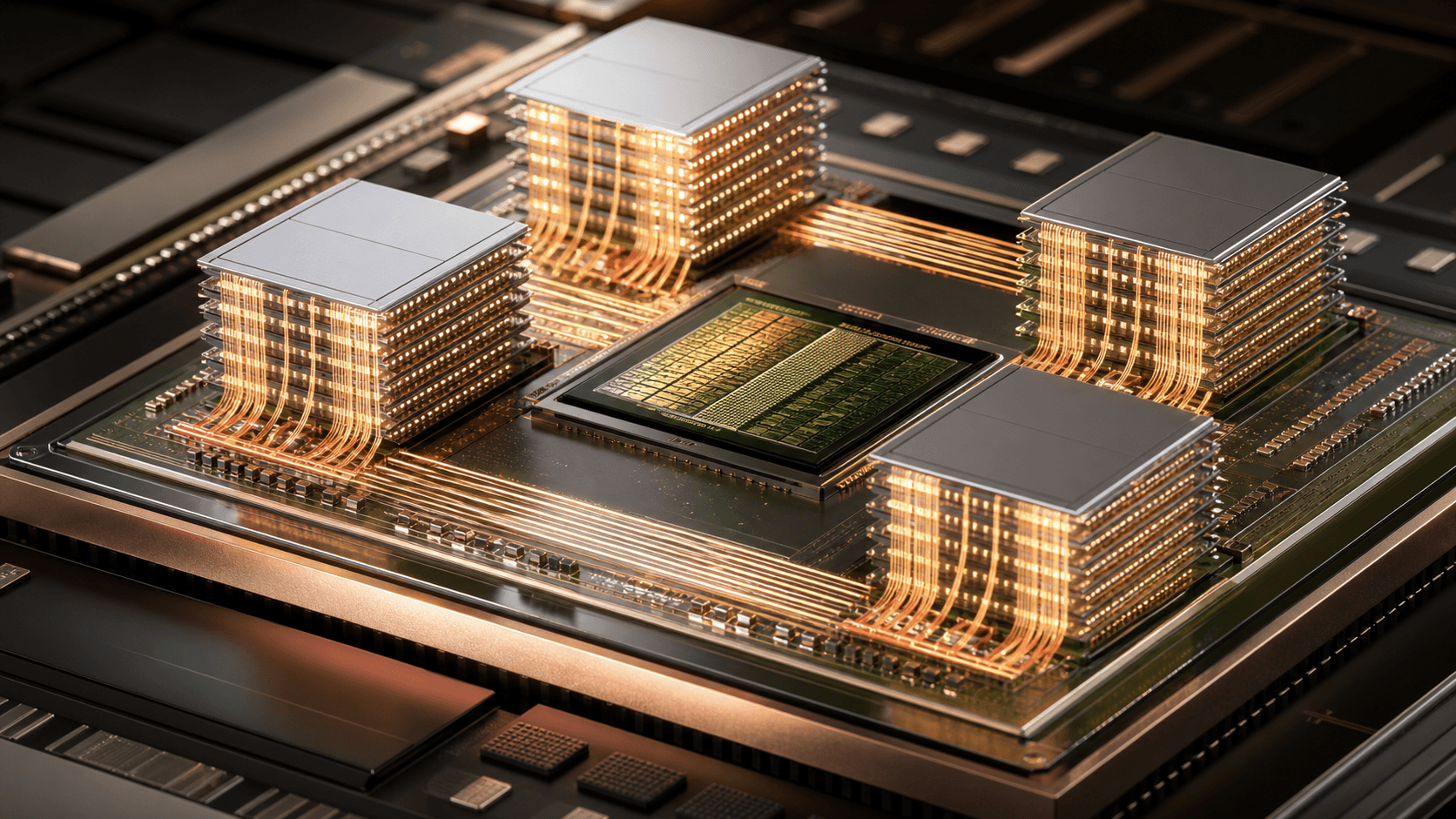
HBM stands for high-bandwidth memory. It is designed to move a very large amount of data between memory and a processor in a short time. Instead of placing separate memory packages farther away on a circuit board, manufacturers stack multiple DRAM dies and position those stacks next to the GPU on a silicon interposer. Thousands of short, wide connections feed the processor. The arrangement provides enormous aggregate bandwidth with better energy efficiency per transferred bit than a design that depends only on very high signaling speed across longer traces.
That description matters because compute units cannot work on data they do not have. A modern AI GPU may contain an extraordinary number of arithmetic units, but model weights, activations, gradients, and cached context must arrive continuously. If memory cannot keep up, parts of the processor wait. Adding more compute then produces a smaller gain than the headline number suggests. HBM is not glamorous storage attached after the design is finished; it is part of the performance architecture that determines how much of the GPU can be kept busy.
How stacking creates a wider path
An HBM package combines several DRAM dies vertically. Tiny through-silicon vias connect the layers, and the finished stack sits close to the GPU on an interposer that carries a very wide interface. Physical proximity shortens the electrical path. Width allows a huge number of bits to move in parallel without driving every signal at the extreme rates used by narrower interfaces. For data centers, the efficiency matters because thousands of accelerators multiply every watt consumed by memory movement and every watt that cooling must remove.
The engineering is difficult. Manufacturers need known-good memory dies, precise vertical connections, large interposers, advanced packaging, and reliable final testing. A defect in one component can reduce the value of an expensive package. Thermal stress must be managed across stacked memory and a hot compute die. Consequently, HBM capacity cannot be expanded like ordinary commodity memory with a simple board change. It depends on a coordinated supply chain for DRAM, packaging, substrates, testing, and cooling, which is why it can constrain accelerator shipments.
Why AI models are hungry for memory bandwidth
Training repeatedly moves model weights, activations, optimizer state, and gradients. Inference reads weights and maintains key-value cache and intermediate state for incoming requests. Larger models, longer context windows, multimodal inputs, and more concurrent users all increase pressure on memory. Some operations are compute-bound, but many are limited by how quickly data can be delivered. When a workload is memory-bound, doubling theoretical arithmetic does not double useful throughput because the new units spend more time waiting.
Capacity and bandwidth describe different limits. Capacity determines how much of the model, context, and batch can remain close to the processor. Bandwidth determines how quickly those bytes can be read and written. More capacity can reduce the need to split a model across GPUs; more bandwidth can raise token throughput or keep larger batches moving. Neither number operates alone. Software layout, quantization, attention design, caching, and communication among accelerators determine whether the hardware’s theoretical memory capability becomes real application performance.
HBM compared with GDDR
GDDR is the fast graphics memory used successfully in consumer GPUs and many workstations. Its packages are typically distributed around the GPU on a board and use narrower channels operating at high signaling rates. The approach offers a practical balance of cost, capacity, board design, and performance for games and creative applications. HBM uses stacked dies, a much wider interface, and advanced packaging to achieve exceptional aggregate bandwidth in a compact area near the processor, usually with better energy efficiency per bit moved.
That does not make HBM the universal replacement for GDDR. A gaming card, laptop, or affordable workstation has different price and packaging constraints from a data-center accelerator serving a large model around the clock. GDDR can be the right engineering choice where its bandwidth is sufficient. HBM earns its cost when memory movement limits expensive compute and when energy, density, and throughput justify the package. The memory technology therefore reveals the product’s target workload, but it does not guarantee leadership in every benchmark.
What HBM3e and HBM4 change
Each generation raises some combination of bandwidth, capacity, speed, stacking, and interface capability. NVIDIA lists the H200 with 141 GB of HBM3e and 4.8 TB/s of memory bandwidth. Its HGX documentation describes newer Blackwell configurations reaching up to 8 TB/s, while the B300 is listed with 288 GB of HBM3e. The exact comparison depends on system configuration, but the scale shows why memory is now a first-class accelerator specification rather than a secondary line in a table.
The Rubin platform moves toward HBM4. NVIDIA says HBM4 doubles interface width compared with HBM3e and that Rubin can provide up to 22 TB/s of bandwidth and up to 288 GB of capacity, roughly 2.8 times Blackwell’s bandwidth. Those are announced platform figures, not an independent promise for every model. Delivered performance will also depend on software, interconnects, thermal limits, power, and whether a workload can use the extra bandwidth instead of encountering another bottleneck elsewhere.
Why HBM became a supply-chain story
AI infrastructure growth created demand not only for leading-edge compute wafers but also for stacked memory and advanced packaging. A supplier must produce good DRAM dies, assemble stacks, connect them through an interposer, and test the complete package at high yield. New capacity requires equipment, facilities, qualification, and time. If HBM or packaging supply is short, finished accelerator output can be limited even when the GPU die itself is available. Memory agreements and packaging plans therefore matter to the industry almost as much as a new architecture announcement.
For buyers, HBM affects total system economics. A GPU with enough local capacity may avoid splitting a model across additional devices and reduce communication overhead. Higher bandwidth may serve more requests or lower latency, but only for workloads that are genuinely memory-bound. Buying the largest specification without measuring model size, context length, concurrency, precision, and service targets can lock capital into unused capacity. Procurement should begin with the workload and cost per useful result, not with the most impressive accelerator brochure.
HBM does not remove every bottleneck
Fast memory cannot compensate for every weak layer. In a cluster, data also crosses GPU interconnects, network switches, storage, and host memory. A slow link can simply move the bottleneck away from HBM. Poor batching, fragmented allocation, an unoptimized model, or inefficient attention cache can waste expensive capacity. Techniques such as quantization, better scheduling, model compression, and cache management may improve delivered performance more economically than a hardware upgrade. The application has to be engineered for the memory system it receives.
Power and cooling remain central. HBM can be efficient per bit, but an accelerator package capable of moving terabytes every second still sits inside a power-hungry system. Rack density, liquid cooling, network design, and electricity supply must be planned together. A data center that counts GPUs without modeling power and data movement may discover a different constraint after installation. AI infrastructure is a system, and HBM is one crucial layer connecting the model’s information to the silicon that computes it.
How to read an HBM specification
Compare capacity, bandwidth, memory generation, accelerator interconnect, power, and the exact workload together. Capacity can decide whether a model fits on one device. Bandwidth can limit token generation or training utilization. Yet a vendor number should be validated with the same model architecture, precision, batch size, and context length you intend to use. A benchmark that changes several variables at once cannot tell you what the memory alone contributed. Useful purchasing evidence is specific, reproducible, and connected to service cost.
Primary specifications are available in NVIDIA’s HGX architecture documentation and its Rubin platform overview. The HGX reference lists H200, B200, and B300 memory configurations, while the Rubin article explains the announced HBM4 interface and bandwidth change: https://docs.nvidia.com/enterprise-reference-architectures/hgx-ai-factory/latest/components.html and https://developer.nvidia.com/blog/inside-the-nvidia-rubin-platform-six-new-chips-one-ai-supercomputer/
“Good technology journalism helps the reader make a better decision after reading.”
About the author

Emma Wilson
AI Editor
Emma writes about applied AI, automation strategy, platform shifts, and the practical impact of emerging technology on companies.