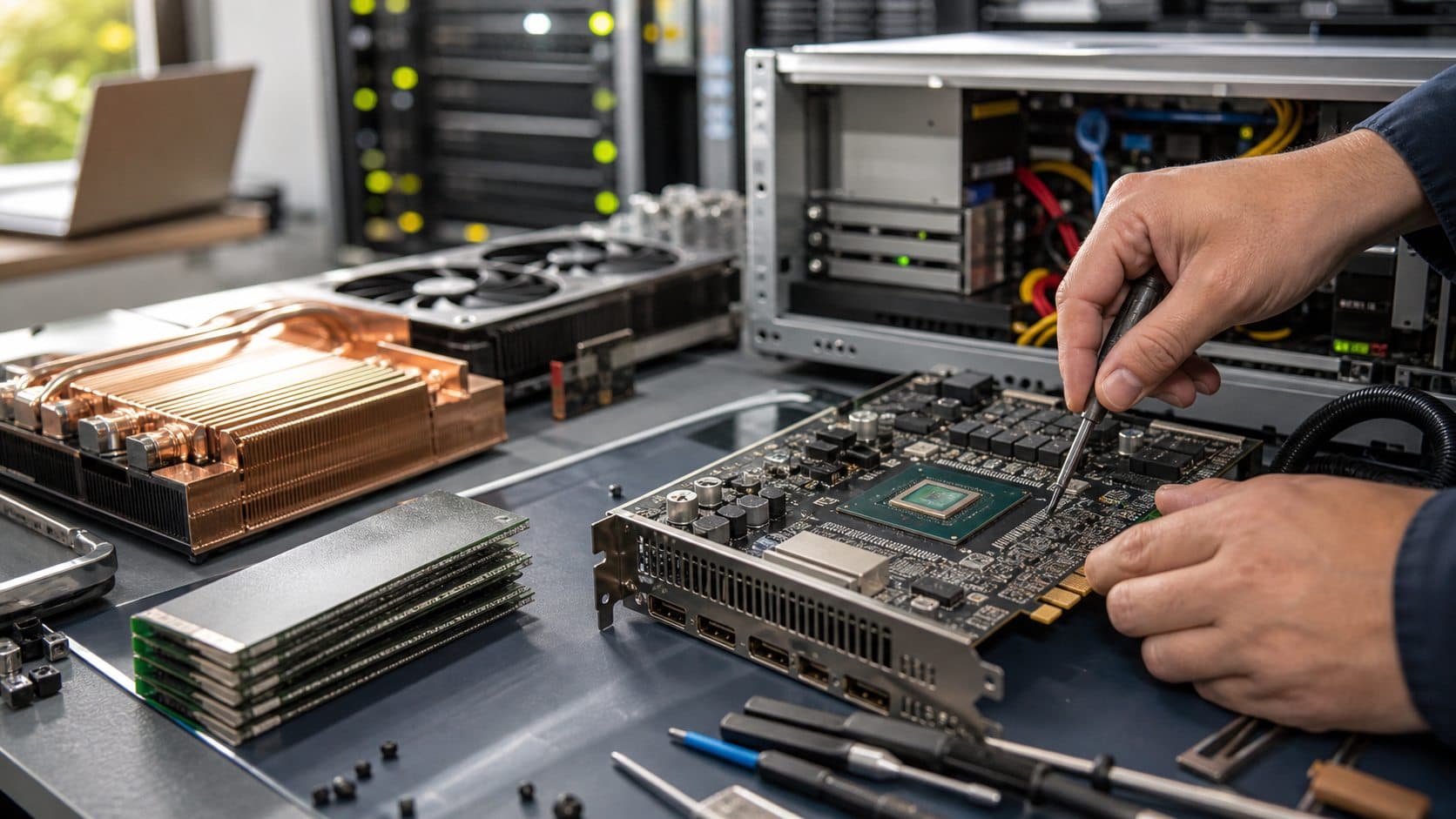

AI’s Next Bottleneck Is Memory, Not Just Bigger Models
As governments and chipmakers race to expand AI capacity, the constraint is shifting from model ambition to high-bandwidth memory, packaging, power and supply-chain discipline.

Infrastructure Editor

Key takeaways
- AI capacity is now constrained by memory bandwidth, packaging, power delivery and manufacturing coordination, not only by model design.
- For product and infrastructure teams, the practical question is how to build roadmaps that survive GPU scarcity, memory shortages and rising data-center costs.
- The winners will treat chip access as operational strategy: forecast demand, diversify suppliers, control inference budgets and design features that degrade gracefully.
Summary
The AI industry spent the last cycle talking about larger models. The next cycle is more physical: memory stacks, advanced packaging, power contracts, data-center cooling and the fragile choreography of semiconductor supply. Recent market moves and national investment plans show the same signal from different angles: AI is no longer only a software race; it is a manufacturing and logistics race.
High-bandwidth memory matters because modern AI systems do not simply need chips that can calculate. They need chips that can keep data moving fast enough to avoid wasting the expensive compute around them. When memory bandwidth is scarce, the bottleneck appears as slower training runs, more expensive inference, delayed launches and painful tradeoffs in product design.
This changes the work for technology leaders. A roadmap that assumes infinite compute will keep breaking. A better roadmap treats compute as a constrained input, like cash or engineering time. Teams should model capacity early, define priority tiers, and decide what happens when the preferred accelerator, region or memory configuration is unavailable.
Article
The simple story says AI gets better when models get bigger. The useful story is messier. A model must be trained, served, monitored, cooled, secured and paid for. Each step depends on physical infrastructure, and the tightest constraint is often not the most glamorous part of the stack. In 2026, that constraint increasingly looks like memory bandwidth and the supply chain that surrounds it.
High-bandwidth memory, especially the stacks used next to advanced AI accelerators, is hard to make at scale. It depends on yield, packaging capacity, substrate availability, testing time and long supplier commitments. If one layer slows down, the whole system slows down. A cloud region may have enough floor space but not enough power. A chipmaker may have demand but not enough packaging throughput. A startup may have a model ready but not enough predictable inference capacity to launch it responsibly.
For readers building products, this matters because infrastructure scarcity leaks into user experience. A feature that looks instant in a demo can become too expensive in production. A customer-facing assistant may need rate limits. A video model may require queues. A coding agent may need a cheaper fallback model for routine tasks. These are not failures of imagination; they are responsible design decisions when compute is finite.
The right response is not panic buying. It is capacity-aware product planning. Teams should separate workloads into tiers: critical real-time paths, batch jobs, experiments, internal tools and optional premium experiences. Each tier should have a target cost, latency budget, fallback model and shutdown rule. When finance, engineering and product share that map, the company can make tradeoffs before a shortage becomes a crisis.
There is also a geopolitical layer. Countries are treating chip capacity as strategic infrastructure, because AI systems increasingly touch defense, health, finance, logistics and public services. That does not mean every company needs to become a semiconductor expert. It does mean every serious AI roadmap needs a supply-chain risk section: where the compute is hosted, who controls the hardware, what export rules apply, and how quickly the service can move if the market changes.
The companies that look disciplined may appear slower at first. They will delay flashy launches, reduce unnecessary inference calls, cache more aggressively, and design narrower workflows. But that discipline compounds. Their margins are clearer, their reliability is higher, and their teams understand the true cost of every new AI promise.
The next AI advantage may not belong to the team with the loudest model announcement. It may belong to the team that knows exactly how much memory, power and latency its product consumes, and has the courage to build within those limits.
“Good technology journalism helps the reader make a better decision after reading.”
About the author

Michael Lee
Infrastructure Editor
Michael covers chips, cloud platforms, data centers, software infrastructure, and the economics behind large-scale computing.