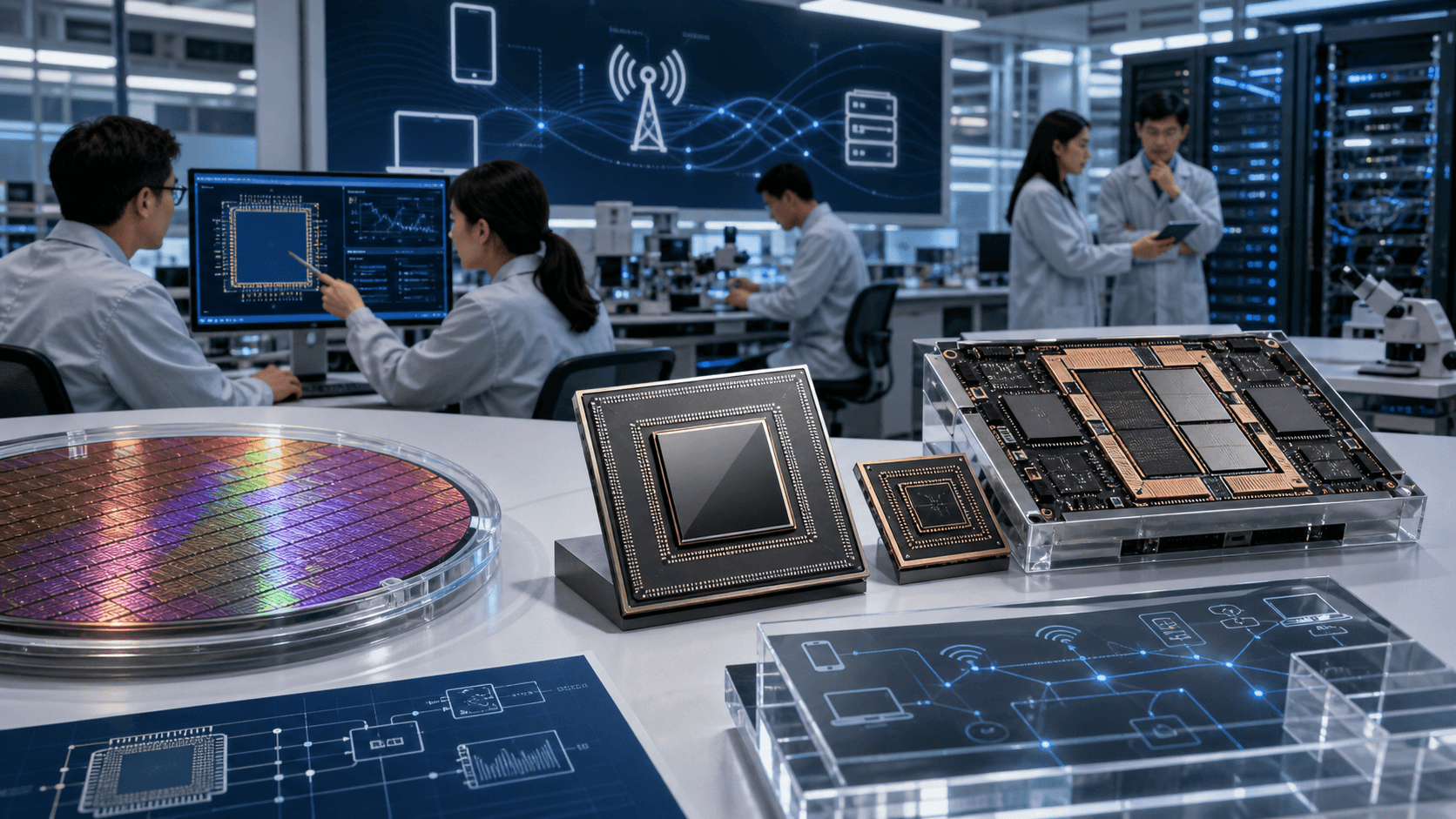

Sub-1nm Chip Research Is a Reminder That AI Efficiency Is Still a Materials Problem
IBM’s sub-1nm nanosheet work is not a product launch, but it points to the physical discipline AI will need as models, devices and data centers demand more efficient computing.

Infrastructure Editor

Key takeaways
- Sub-1nm research matters because AI scaling is increasingly limited by power, memory movement, heat and manufacturing efficiency.
- The breakthrough should be read as a direction of travel, not an immediate product: materials, yield and packaging decide when it reaches real systems.
- Product teams should track chip efficiency because it shapes cloud cost, device capability and which AI features become economically viable.
Summary
Chip progress is often described as a number: smaller node, more transistors, better performance. But the AI era makes that number feel more urgent because every efficiency gain changes the cost of training, inference, edge devices and data-center power. Sub-1nm research is a signal that the industry is still fighting for progress at the material level.
IBM’s recent work around nanosheet scaling below the 1nm class should not be confused with a chip that ships tomorrow. Research results must pass through manufacturing, yield, packaging, economics and ecosystem support. Still, the direction matters: AI cannot simply keep asking for more power and more hardware without improving the physics underneath.
The practical lesson is that software roadmaps depend on semiconductor roadmaps. A more efficient transistor can make a model cheaper to serve, a phone more capable on-device, or a data center less constrained by electricity and cooling. The stack is connected.
Article
The AI industry often talks as if progress lives only in models. Better architectures, better datasets, better alignment, better agents. But every model eventually becomes a workload. It runs on silicon, moves data through memory, produces heat and competes for power. That is why semiconductor research still matters deeply.
Sub-1nm work is not a magic switch. At such scales, the physics becomes unforgiving. Leakage, variability, materials stability and manufacturing precision all become central. A lab result has to survive the industrial reality of repeatable production. The hard question is not only “can it work?” but “can it work millions of times at acceptable cost?”
For AI infrastructure, the promise is efficiency. If transistors switch with less power and can be packed or organized more effectively, cloud providers gain options. They can reduce cost per token, offer more capacity in constrained regions, or move more AI tasks onto smaller devices. Each improvement changes product economics.
The device story is just as important. On-device AI needs useful performance without burning battery or turning phones and laptops into heaters. Smaller and more efficient transistor designs can help local inference become ordinary rather than premium. That matters for privacy, latency and resilience when cloud capacity is expensive.
But teams should avoid reading research as a near-term procurement plan. Between a lab milestone and production hardware sit years of integration work: design tools, foundry process, packaging, testing, supply-chain qualification and software support. The impact is real, but it arrives through disciplined engineering rather than headlines.
The best way to follow chip research is to ask what constraint it relaxes. Does it reduce power? Improve density? Help memory? Lower cost? Enable edge deployment? AI progress will not be one breakthrough. It will be thousands of constraint reductions stacked together.
“Good technology journalism helps the reader make a better decision after reading.”
About the author

Michael Lee
Infrastructure Editor
Michael covers chips, cloud platforms, data centers, software infrastructure, and the economics behind large-scale computing.