
Edge AI for Small Factories: From Sensor Noise to Better Decisions
Many factories install sensors with excellent intentions and quickly discover they are drowning in logs, alerts, and uncertain recommendations. The reason is simple: they treat data as a stream to be collected, not a signal to be interpreted.

Infrastructure Editor
Key takeaways
- Many factories install sensors with excellent intentions and quickly discover they are drowning in logs, alerts, and uncertain recommendations. The reason is simple: they treat data as a stream to be collected, not a signal to be interpreted.
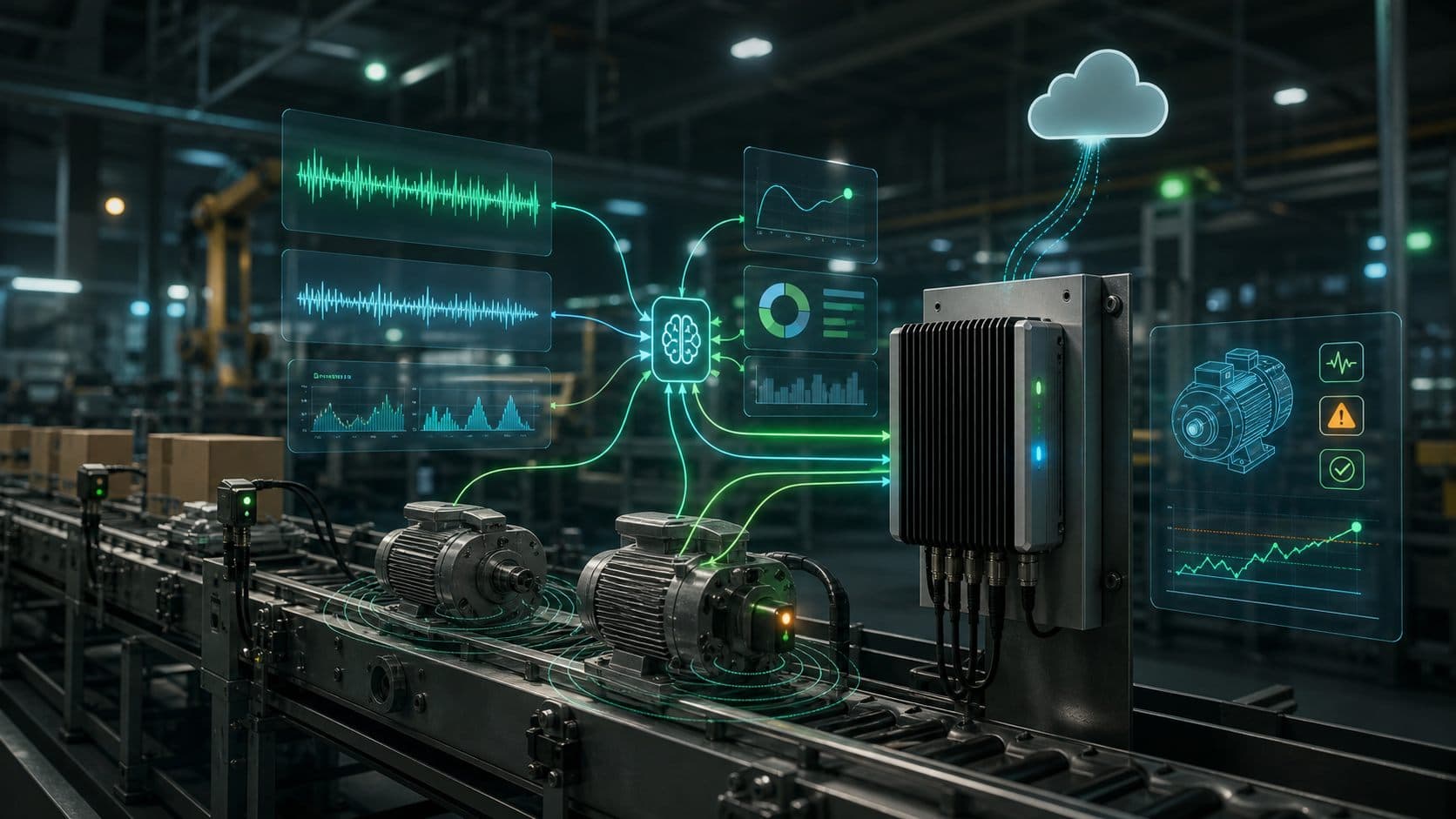
- Edge AI changes the sequence. By computing locally, teams can classify what matters before sending data upward. This reduces delay, preserves bandwidth, and lets floor operators react in real time instead of reading a report hours later.
- The article lays out a practical architecture where local inferencing handles the first response layer, while cloud systems remain responsible for deep diagnostics and enterprise reporting.
Summary
Many factories install sensors with excellent intentions and quickly discover they are drowning in logs, alerts, and uncertain recommendations. The reason is simple: they treat data as a stream to be collected, not a signal to be interpreted.
Edge AI changes the sequence. By computing locally, teams can classify what matters before sending data upward. This reduces delay, preserves bandwidth, and lets floor operators react in real time instead of reading a report hours later.
The article lays out a practical architecture where local inferencing handles the first response layer, while cloud systems remain responsible for deep diagnostics and enterprise reporting.
The most important shift is not hardware-heavy modernization, but operational discipline. Edge AI is effective when it is paired with event hierarchy, maintenance playbooks, and local accountability. A vibration anomaly without context is noise; an “edge-confirmed anomaly cluster” can trigger a maintenance slot, spare part pre-order, and supervisor notification in one predictable path.
This is where small factories gain: lower false alarms, fewer surprise failures, and easier operator trust because the system stops sounding the alarm constantly.
Article
Factories commonly begin with full-width modernization plans: rewrite controllers, replace every PLC, and build a cloud dashboard with charts for everything. Costs escalate, but insights stay shallow because signal quality is poor. Start from the opposite direction—process simplification first.
Choose one production line and map only three to five measurable incidents: abnormal heat spikes, vibration frequency drift, belt stalls, motor current irregularities, and unexpected idle windows. The edge node should not infer every pattern; it should evaluate a constrained set and escalate only high-confidence events.
The practical stack is usually: local ETL, local feature extractor, lightweight model runtime, then event queue to central platform. For example, instead of transmitting every vibration sample, compute root metrics every minute and store them as compact summaries. This reduces storage pressure and helps operators see trends.
Pair this with two-level thresholds. Level 1 alerts can be visual-only for the operator to review within routine rounds. Level 2 alerts should auto-issue maintenance tickets with location, last maintenance timestamp, and suggested action. With this, the team gains operational rhythm.
Most false positives come from environmental variation, not component failure. So seasonality and shift-specific baseline profiles should be embedded. If the night shift has predictable load swings, models must learn those patterns; otherwise they will train the team to ignore alerts.
In the governance layer, schedule monthly calibration windows where technicians tag events as “true issue,” “sensor noise,” or “process variation.” This keeps the model relevant and prevents data drift.
As systems mature, edge nodes can host two models: a fast detector and a secondary confidence model. The second model does not replace the first; it validates whether escalation should happen. Combined, they cut unnecessary shutdowns and preserve production continuity.
The long-term benefit is not only technical uptime but team confidence. Workers begin to trust the system as an informed co-worker, not an unpredictable noise source.
“Good technology journalism helps the reader make a better decision after reading.”
About the author

Michael Lee
Infrastructure Editor
Michael covers chips, cloud platforms, data centers, software infrastructure, and the economics behind large-scale computing.