

Europe’s AI Gigafactory Push: Why the Real AI Race Is Now About Infrastructure
Europe’s plan for seven AI gigafactories is not just a data-centre story. Power, chips, cooling, networks and fair access now shape who can compete.

Infrastructure Editor
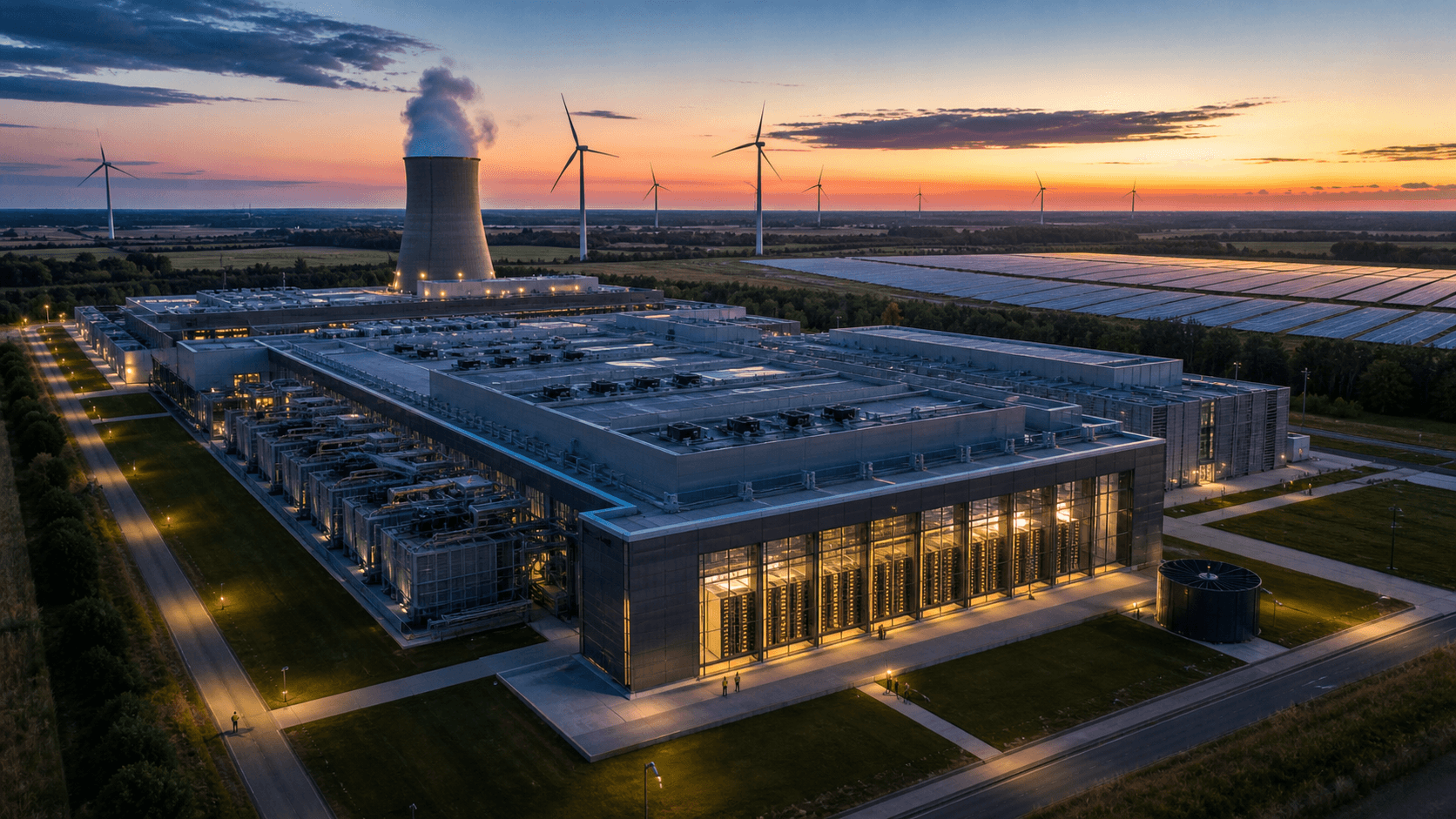
Europe is planning capacity, not merely announcing a building
The European Union has opened a push for seven AI gigafactories: very large facilities intended to bring together compute, data-centre capacity, storage, networking and the operating discipline needed for advanced AI. It would be a mistake to picture seven finished buildings switching on tomorrow. Site selection, private partners, permits, grid connections and construction still matter. The signal is important precisely because it arrives before those details are settled. Europe is treating large-scale compute less like an invisible cloud utility and more like economic infrastructure that shapes who can build, train and deploy AI.
The Commission has already said that the early interest process attracted dozens of proposals from member states and potential sites. That does not guarantee every proposal becomes a facility; it does show that demand for sovereign and regional capacity is real. The useful question is not whether a gigafactory sounds impressive. It is whether it gives researchers, smaller companies, public institutions and industry dependable access to the machines, data services and support that turn a promising model into a useful product. In 2026, the map of AI is being drawn by substations, fibre routes, procurement schedules and operations teams as much as by research labs.
A frontier model is only as strong as the system around it
AI coverage often becomes a scoreboard: which model tops a benchmark, writes cleaner code or produces the most convincing demo. Those comparisons have value, but they describe only one layer. A capable model without enough accelerators, memory bandwidth, fast networking and resilient data-centre space cannot serve real demand. And after training is finished, every chat response, image, video, search result and agent action still consumes compute. Inference is not an afterthought; for a successful AI product, it becomes the daily operating bill.
That changes what competitive advantage looks like. A company can impress people on launch day yet still disappoint them if latency rises, capacity becomes scarce or the price of each useful task is unpredictable. The same is true for regions. The next phase of AI is not a simple contest between algorithms. It is a contest in delivering those algorithms reliably, safely and affordably. Europe’s gigafactory initiative is therefore not a symbolic hardware story. It is a strategic acknowledgement that models live inside systems, and systems have physical limits.
Power and cooling are product decisions now
The word cloud makes computing sound weightless. Large AI is anything but. Dense accelerator racks turn electricity into heat at an extraordinary rate. They need electrical substations, cooling loops, backup systems, water or other thermal strategies, network resilience and years of capacity planning. In many places, the slowest part of a new data centre is not buying hardware; it is winning a grid connection. A project that ignores power, permitting, community impact and heat management can run out of runway long before it runs out of ambition.
This is why a gigafactory is not simply a warehouse with more servers. It must be designed around how each unit of energy becomes valuable work, how workloads move when the grid is constrained and how waste heat, demand peaks and maintenance are managed. Product leaders should take the same lesson at a smaller scale. The cost of an AI feature is not just an API line item. Model choice, prompt size, caching, regional routing, response-time targets and fallback behaviour all affect margin and reliability. Infrastructure design has become part of product design.
The bottleneck is not only the GPU
Accelerators are central to modern AI, but a useful cluster is an orchestra rather than a solo instrument. High-bandwidth memory, advanced packaging, switches, optical links, storage, schedulers and observability tools must work together. If processors wait for data, if networking cannot keep distributed jobs synchronized or if storage stalls a pipeline, expensive hardware sits underused. At gigafactory scale, small inefficiencies compound into very large bills. This is why headline chip counts rarely tell the whole story.
For a smaller engineering team, the equivalent lesson is practical rather than exotic. Do not send every task to the largest available model. Separate extraction, retrieval, classification and routine summarization from high-stakes reasoning. Cache repeatable work, measure failures, and choose a model tier that matches the risk of the task. That is not a retreat from AI ambition. It is how a team preserves budget for the moments where advanced computation creates real value. The infrastructure race rewards disciplined allocation, not indiscriminate consumption.
Sovereignty should mean more choice, not a new silo
Europe’s concern about dependence on a small number of foreign cloud and model providers is understandable. An organization that has only one route to compute can be exposed to price changes, capacity caps, product restrictions and geopolitical friction. But technological sovereignty is useful only if it expands options. It should mean interoperable capacity, credible portability, clear rules for sensitive workloads and enough competition that customers can negotiate. It should not mean sealing off research or declaring every external service a threat.
Access will be the test. If gigafactory capacity is captured exclusively by the largest institutions, the programme may create prestige without much diffusion of value. If startups, universities and specialist teams can obtain time through transparent rules and understandable prices, it can change what is possible across an ecosystem. Governance matters as much as silicon: who gets a queue, what security standards apply, how usage is audited, and whether a small team can understand the route from application to usable compute.
What companies should do before the capacity arrives
Most companies do not need to build a data centre in response to this announcement. They do need a clearer picture of their compute dependency. Which workflows truly require a frontier model? Where is low latency essential to the customer experience? Which data should not leave a controlled environment without a defensible reason? What happens if a preferred provider raises prices or cannot serve a peak? The answers produce an AI operating map that is more valuable than a collection of experiments with no owner.
The practical next step is to make AI architecture reversible. Keep model calls behind a clean interface, evaluate output quality against real work, log cost and latency, minimize the data that travels to third parties and retain a human or simpler fallback for critical paths. Teams that do this are not betting against innovation. They are making room to adopt new capacity when it becomes useful without allowing one vendor, one model or one temporary shortage to decide their product roadmap.
The next headlines that will actually matter
Seven is a memorable number, but the more revealing details will emerge later. Which locations win? How quickly can they connect to reliable power? How much capacity is reserved for training versus everyday inference? Will renewable supply, cooling and local water use be addressed openly? Can smaller organisations obtain access, and will the programme publish enough information for the public to judge progress? Announced funding is a starting point; delivered capacity and fair access are the outcome that matters.
The AI race will not be settled by one press release or one benchmark. It will be shaped by places and companies that connect computation to reliable energy, skilled operators, open competition, sensible governance and products people can actually use. Europe’s gigafactory move makes one thing unusually clear: every apparently magical AI interaction rests on a physical system. As that system becomes scarce and strategic, infrastructure is no longer background. It is part of the headline.
“Good technology journalism helps the reader make a better decision after reading.”
About the author

Michael Lee
Infrastructure Editor
Michael covers chips, cloud platforms, data centers, software infrastructure, and the economics behind large-scale computing.