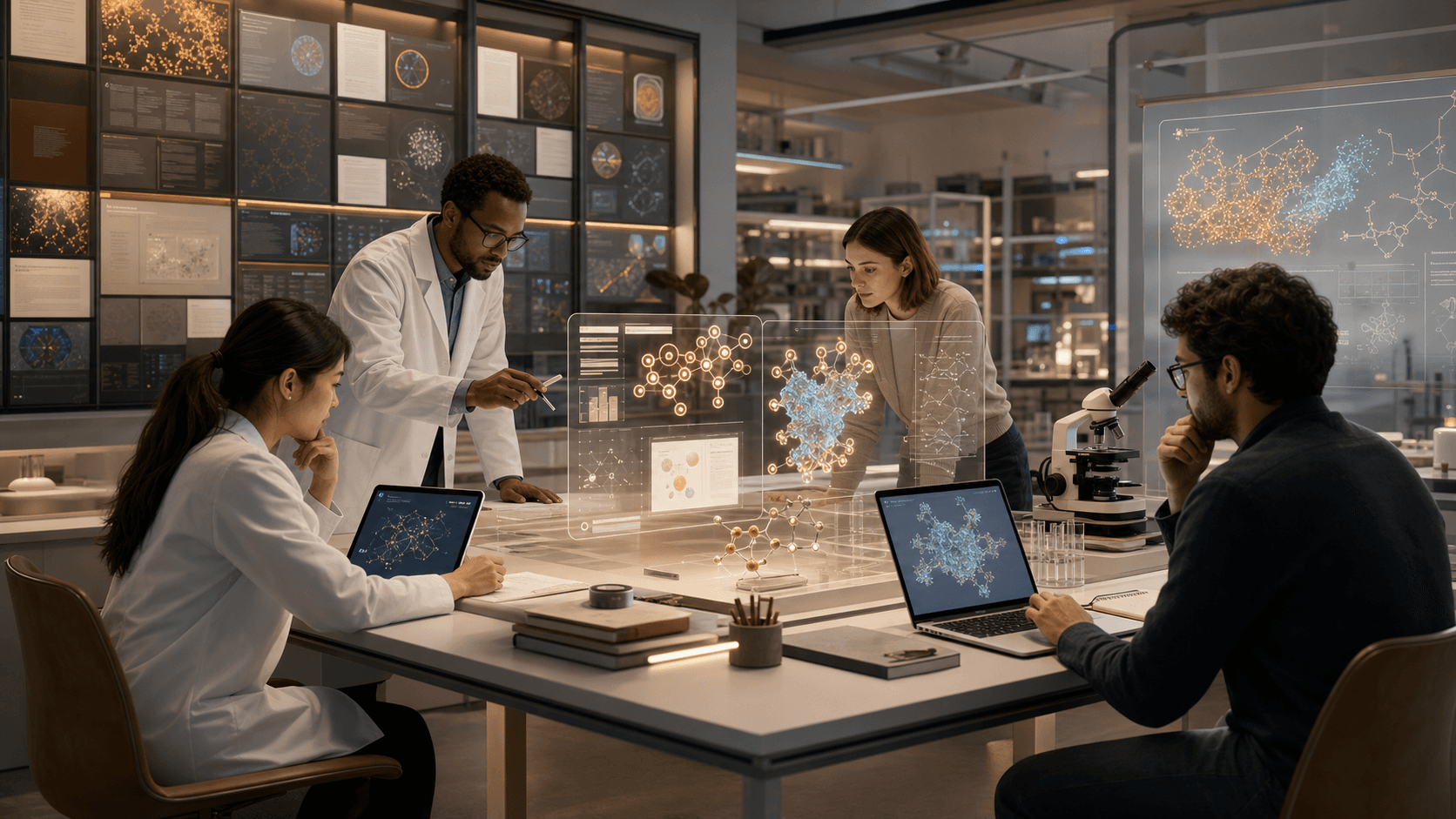

AI Drug Discovery Is Moving From Demo Slides to Real Deal Terms
Recent life-sciences deals show that AI is no longer being sold only as a lab demo. The serious question is where it improves biology, where it only accelerates paperwork, and how teams prove the difference.

AI Editor
The hype is meeting contracts
AI drug discovery has spent years living between two extremes. In one story, algorithms would compress a decade of biology into a few clicks. In the other, the field was dismissed as polished demo software wrapped around old research workflows. The more interesting reality is now emerging in the middle: companies are writing partnerships, paying for milestones, and asking AI systems to prove value inside the messy loop of biology.
That shift matters because drug discovery is not a pure information problem. A model can rank molecules, read papers, predict structures and propose hypotheses, but biology still has the final vote. Cells, toxicity, patient variability, manufacturing and regulation do not disappear because a model produced a beautiful candidate.
The serious phase begins when AI is judged not by slide quality, but by whether it changes decisions: which target to pursue, which molecule to test, which assay to run, and which failure to abandon sooner.
Where AI is actually useful
The strongest near-term use is not magic replacement of scientists. It is compression of search. AI can connect literature, patents, omics data, protein structures, chemical libraries and prior trial signals faster than a human team can hold them in memory. That does not guarantee the right answer, but it can make the next experiment less blind.
AI is also useful as a coordination layer. A drug program is a chain of handoffs: computational biology, chemistry, assay design, lab operations, clinical strategy and regulatory documentation. Models that summarize evidence, expose assumptions and keep a living map of decisions can reduce the silent loss of context that slows programs down.
The danger is treating speed as truth. A faster hypothesis is still a hypothesis. The teams that benefit will pair AI with skeptical scientists, strong data lineage, reproducible notebooks, clear assay design and the discipline to kill attractive ideas when biology says no.
Compute platforms are becoming lab equipment
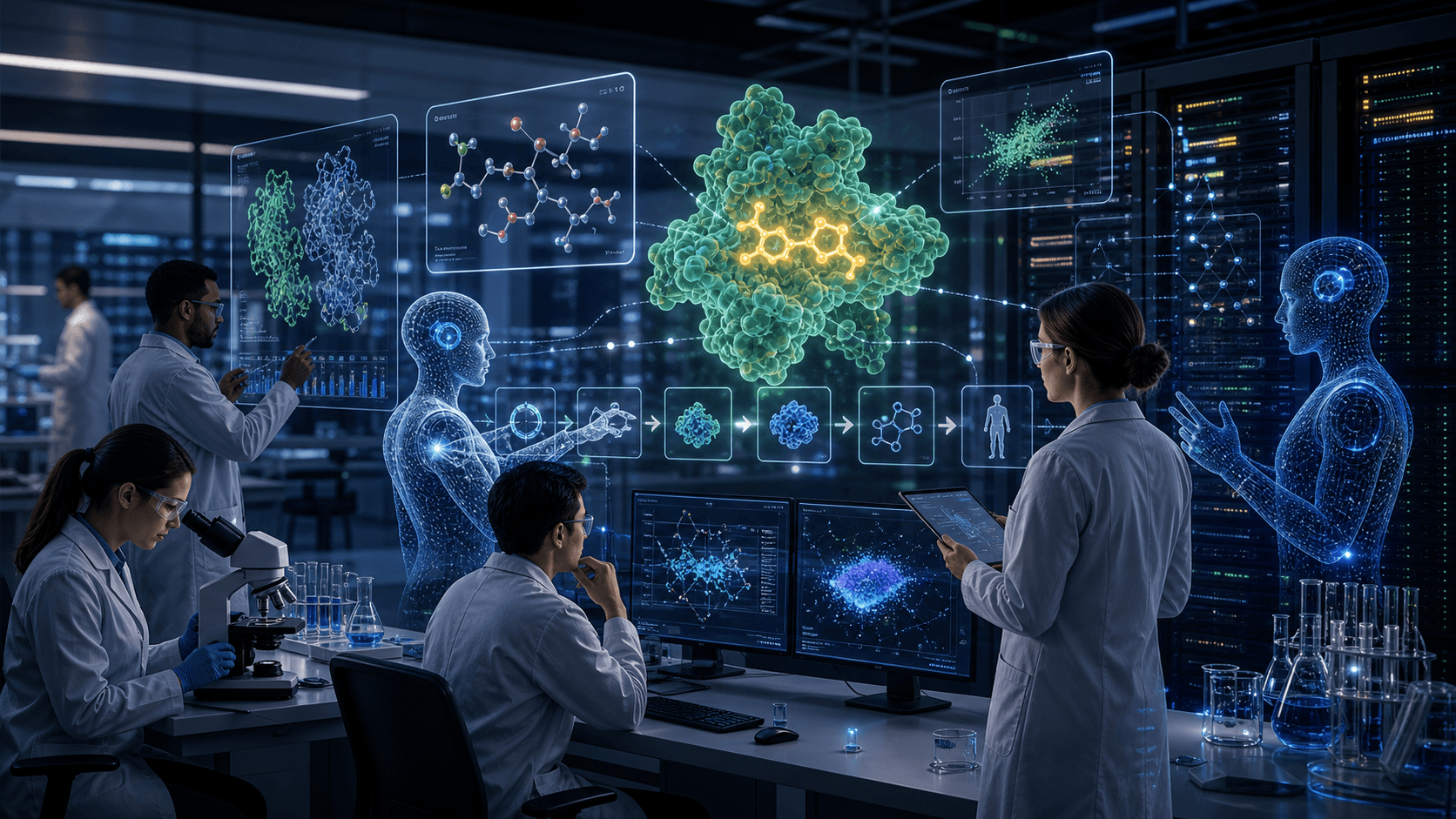
Platforms such as biology foundation models, molecule generation systems and GPU-accelerated workflows are becoming part of the modern lab stack. They do not replace wet labs; they shape what enters the wet lab. That is a meaningful change because each experiment consumes time, money and attention.
The economics are important. If AI can reduce the number of weak candidates, help prioritize mechanisms, or identify safety concerns earlier, it does not need to “solve medicine” to be valuable. It needs to improve the hit rate of decisions that were already expensive.
But platform adoption should come with governance. Teams need to know which datasets trained a model, where bias may enter, how predictions are versioned, and whether a result can be reproduced months later when investors, regulators or partners ask what changed.
What readers should watch
The best signal will not be another glossy promise that AI will discover every drug. Watch for milestone payments tied to validated biology, published experimental results, clinical progression, failed programs discussed honestly, and partnerships where AI changes the design of work rather than only producing a press release.
Also watch the role of human judgment. In life sciences, the strongest AI story is not a machine replacing researchers. It is a team becoming more precise about which uncertainties deserve money and time.
AI drug discovery is becoming real, but real does not mean effortless. The companies that win will be the ones that respect biology enough to let AI accelerate learning without pretending it can repeal uncertainty.
“Good technology journalism helps the reader make a better decision after reading.”
About the author

Emma Wilson
AI Editor
Emma writes about applied AI, automation strategy, platform shifts, and the practical impact of emerging technology on companies.