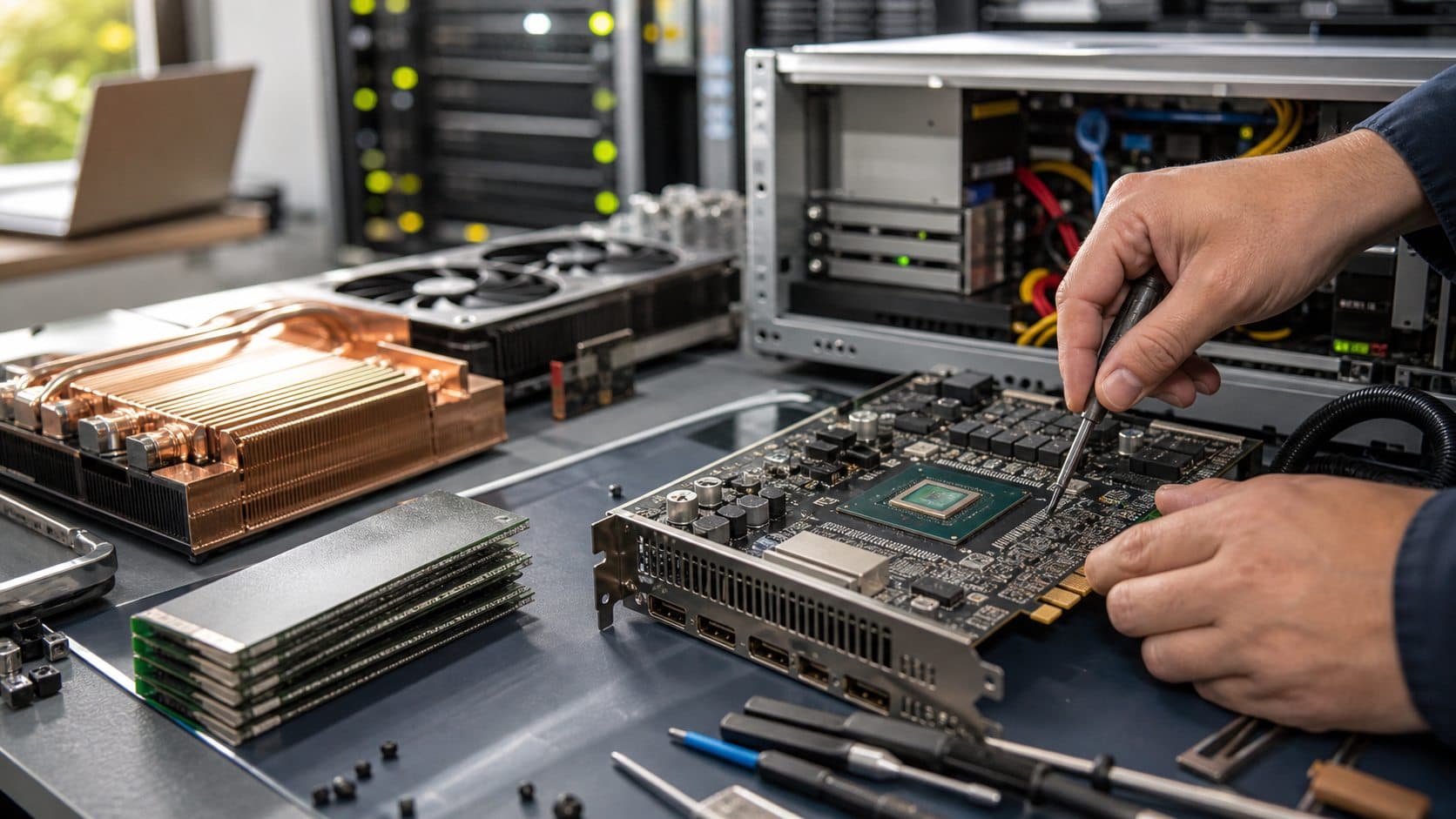

AI Data Centers Are Becoming a Power and Cooling Story
The AI boom is no longer only about models and chips. New data centers now compete for electricity, water strategy, grid connections, cooling design, and local political permission.

Infrastructure Editor

Why this matters now
AI used to sound weightless: prompts, models, tokens, assistants, dashboards. The newest infrastructure wave makes it feel physical again. Behind every instant answer is a chain of chips, racks, substations, cooling loops, transformers, permits, construction crews, fiber routes, power contracts, and local communities deciding whether the promised digital future is worth the physical footprint. This is why the story matters beyond one product release or one corporate announcement. A technology shift becomes important when it changes where responsibility sits. In this case, responsibility moves from a single app or model into the surrounding environment that lets the system act.
The pressure is growing because frontier models and agentic workflows do not only require more GPUs. They require predictable electricity, heat removal, land, construction timing, backup systems, and grid interconnection. A model can be ready before the building, and a building can be ready before the power line. In AI, the slowest physical dependency can become the real product roadmap. The practical result is that leaders can no longer treat the issue as background infrastructure. It changes risk, pricing, product design, customer education, and the way teams decide which automation belongs in production. The winners will not be the loudest adopters. They will be the ones that can explain how the system works when something goes wrong.
The new boundary
For cloud buyers, startups, governments, media companies, factories, hospitals, and ordinary users, this is not an abstract engineering story. It affects latency, price, service availability, environmental politics, and whether AI tools stay affordable enough for smaller teams outside the richest technology centers. That boundary is not only technical. It is also legal, operational, and emotional. Users do not judge a system only by what it can do on a perfect day. They judge it by whether it protects them when the environment is confusing, adversarial, expensive, or under pressure.
Recent data center announcements show the same pattern: AI capacity is being discussed alongside grid upgrades, cooling technology, land use, local jobs, environmental questions, and the politics of who receives power first. The older internet assumed people would interpret pages, buttons, warnings, prices, and instructions. The newer internet increasingly asks software to interpret those things for people. That sounds efficient, but it changes the attack surface and the accountability model at the same time.
A practical response
Who inside a company is responsible for deciding when an AI task truly needs the most expensive model, the fastest GPU, and the hottest infrastructure path? The answer should be written into the workflow before adoption scales. Define the owner, define the allowed actions, log the sensitive moments, create a rollback path, and give users visible control when the system is about to cross a meaningful line.
The second step is to test with realistic failure, not only ideal success. Put the system in front of messy pages, ambiguous requests, stale data, conflicting instructions, edge cases, and cost pressure. A tool that performs well only in a clean demo is not ready for the real internet, real companies, or real households.
What to measure
Usage alone is a weak metric. A dangerous system can be used often because it is convenient, not because it is trustworthy. Better measurement combines adoption with error rates, rework, user overrides, support tickets, audit findings, security incidents, cost per successful outcome, and time saved after review.
Teams should also measure reversibility. How quickly can they stop a workflow, revoke a permission, replace a vendor, change a model, undo a bad action, or return to manual operation during an incident? If the answer is unclear, the organization has accepted a dependency without understanding its price.
Mistakes to avoid
The first mistake is treating trust as a marketing claim. Trust is not a word in a launch post. It is an operating property that appears in defaults, permissions, logs, warnings, handoffs, billing, security reviews, and customer support. If users cannot see or challenge important decisions, trust becomes decoration.
The second mistake is letting teams optimize only for speed. Speed matters, but speed without boundaries creates cleanup work that rarely appears in the original ROI calculation. The best deployments use automation to remove low-value friction while making high-impact decisions more visible, not less visible.
What comes next
The winners will not simply buy more chips. They will route workloads intelligently, use smaller models where possible, plan energy like a strategic asset, design efficient cooling, and earn trust from the communities that host the machinery of AI. That future will not arrive through a single dramatic product launch. It will arrive through many defaults: which tasks are scoped, which actions need confirmation, which logs are retained, which costs are shown, and whether the people affected can understand the system.
If your favorite AI service suddenly became slower, more expensive, or limited by usage caps, would the cause be software demand or a physical infrastructure bottleneck? That question turns a trend into a decision. The most useful technology writing does not only ask what a tool can do. It asks what kind of responsibility becomes normal after the tool becomes ordinary.
“Good technology journalism helps the reader make a better decision after reading.”
About the author

Michael Lee
Infrastructure Editor
Michael covers chips, cloud platforms, data centers, software infrastructure, and the economics behind large-scale computing.